The Great Miami Hurricane of 1926: What Its 100th Anniversary Means for Genealogy

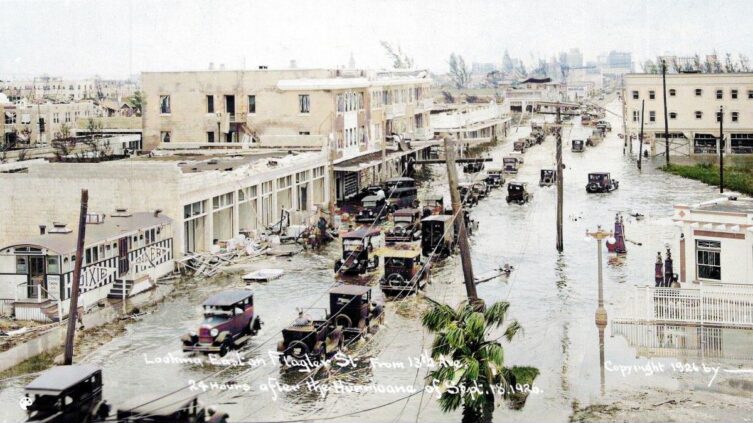
On September 18, 1926, a powerful hurricane struck the Miami area before crossing South Florida and entering the Gulf of Mexico. It tore apart homes and businesses, flooded coastal communities, displaced tens of thousands of people, and helped bring the region’s celebrated land boom to an abrupt end. A century later, the Great Miami Hurricane remains one of the most consequential natural disasters in Florida history.

For genealogists, the centennial is more than an occasion to revisit the storm’s scale. Disasters can redirect lives in ways that appear throughout the historical record: a family leaves town, relatives take in survivors, an occupation changes, property passes through probate, or a familiar address disappears from the next directory. By examining records from before and after September 1926, researchers may uncover how the hurricane altered a family’s path.
Key takeaways about the Great Miami Hurricane
- The Great Miami Hurricane made landfall near Miami Beach early on September 18, 1926, with the strength of what would now be classified as a Category 4 hurricane.
- The official death toll remains uncertain. A Red Cross report listed 373 deaths and 6,381 injuries, while many people were reported missing.
- The storm affected communities across South Florida and later made another U.S. landfall near the Alabama–Florida border.
- Census records, city directories, newspapers, death records, property files, probate cases, cemetery records, maps, and photographs can help reconstruct a family’s experience.
- A sudden disappearance from local records does not necessarily mean that a person died. Evacuation, displacement, hospitalization, relocation, and changes in recordkeeping are also possible explanations.
What happened during the Great Miami Hurricane?
Miami was expanding at extraordinary speed in the mid-1920s. Dade County had counted 42,753 residents in the 1920 U.S. census, but its population had grown to well over 100,000 by September 1926, according to the National Weather Service. Construction was widespread, newcomers were arriving rapidly, and many residents had little experience with hurricanes.
The storm was first identified northeast of the Lesser Antilles on September 14. It moved through the Bahamas and reached the South Florida coast in the early hours of September 18. Modern analysis classifies it as a Category 4 hurricane at its Miami-area landfall.
The eye passed over the city, bringing a deceptive period of calm. Some residents emerged from shelter, unaware that the storm’s most violent winds would soon return from the opposite direction. The second half of the hurricane brought renewed destruction. Storm surge inundated Miami Beach and areas around Biscayne Bay, while powerful winds damaged buildings, utilities, boats, roads, and rail lines.
After crossing the peninsula, the hurricane moved into the Gulf of Mexico and made another landfall near the Alabama–Florida border on September 20. Its effects extended well beyond Miami, including severe damage in Fort Lauderdale, Hollywood, Moore Haven, and communities along the northern Gulf Coast.
Why the storm’s human toll is difficult to measure
The Great Miami Hurricane caused over $100 million in damage at the time — over $164 billion in today’s dollars — and left more than 40,000 people homeless. Its precise death toll is harder to establish. The National Hurricane Center cites a Red Cross report that listed 373 deaths and 6,381 injuries. It also notes that more than 800 people were missing after the storm.
Several factors complicated the count. South Florida had a large, mobile population that included recent arrivals, seasonal residents, laborers, tourists, and people living in newly developed neighborhoods. Some victims may not have appeared in local records before the hurricane. Others left the area afterward or were temporarily separated from relatives. Bodies were not always recovered or immediately identified.
For family historians, this uncertainty is a reminder that an official total and an individual family’s experience are different kinds of evidence. A death certificate may document one victim, a newspaper may report another person missing, and a later census may show that someone believed lost had resettled elsewhere. Each source answers a different question.
How the hurricane can appear in family history records
Natural disasters rarely create one complete, easily searchable list of everyone affected. Their impact is usually scattered across records produced for other purposes. The most effective approach is to establish what is known before the storm, then follow each person through the months and years that followed.
Federal census records
The 1920 and 1930 U.S. federal censuses provide useful reference points on either side of the hurricane. Compare household members, addresses, occupations, birthplaces, immigration details, and housing information. The 1930 U.S. federal census on MyHeritage may show whether a family remained in South Florida, moved to another county or state, changed occupations, or combined households with relatives.
A change between the two censuses is a clue, not proof that the storm caused it. Marriage, employment, health, economic conditions, and ordinary migration may also explain the difference. Look for supporting evidence before drawing a conclusion.
City directories
Because federal censuses were taken 10 years apart, city directories can bring the timeline much closer to September 1926. Directories often list adult residents, spouses, occupations, employers, and street addresses. Search the U.S. City Directories collection on MyHeritage for entries before and after the hurricane.
Aside from noting whether a person was present or absence, pay attention to additional details. Were they designated a widow or widower? Did they begin a new occupation, or work for a different employer? Did they move to a different address? All these may indicate that they were affected by the hurricane. Consult the directory’s publication date and introductory pages when possible: information may have been collected months before the year printed on the cover.
Death records, obituaries, and cemetery sources
If a relative may have died in the storm, search death certificates, county death records, cemetery registers, burial databases, funeral-home records, obituaries, and death notices. The Florida County Deaths collection on MyHeritage contains records from 1925 onward, although coverage varies by county and period.
Try a range of dates around September 18 rather than limiting the search to the day of landfall. An injured person may have died later, and registration could have been delayed amid widespread disruption. Search with flexible spellings, initials, nicknames, and broader geographic settings. An unidentified or badly transcribed entry may not appear under the expected name.
Historical newspapers
Newspapers reported casualty lists, missing people, hospital admissions, relief efforts, funerals, property damage, and the movements of survivors. Local coverage can reveal small details that never entered a government record, while newspapers in a person’s former hometown may have published news received from relatives in Florida.
Search for a surname alongside an address, employer, neighborhood, or relative’s name. Also try phrases such as “Miami hurricane,” “reported missing,” “among the injured,” “storm refugee,” and “returned from Florida.” Early reports were often incomplete or wrong, so follow the coverage for several days or weeks and corroborate important claims with later records.
Property, court, and insurance records
Deeds, mortgages, tax rolls, building permits, probate files, guardianship cases, and court records may show what happened after a home or business was damaged. A property might have been sold quickly, transferred within a family, rebuilt, or abandoned. Probate records can identify heirs and relatives even when a death record offers little information.
These materials may be held by county clerks, courts, local archives, historical societies, or libraries rather than in a single online database. Search under both Miami and Dade County; the county was renamed Miami-Dade County in 1997.
Maps, photographs, and relief records
Historical maps can place an address in relation to the coast, waterways, rail lines, and heavily damaged neighborhoods. Photographs from the Florida Memory historic hurricane collection and the Library of Congress can add visual context.
Relief organizations, hospitals, churches, civic groups, and government agencies also generated correspondence, reports, lists, and case files. Survival of these records varies, and access may be restricted in some cases. Repository catalogs and finding aids are often more useful than a general name search, especially when records have not been digitized.
A step-by-step research strategy
Here are some guidelines for researching family members who may have been affected by the hurricane:
- Start with a confirmed identity. Record the person’s full name, relatives, occupation, and last known address before the hurricane.
- Build a narrow timeline. Look for records from 1925 through 1927, including directories, newspapers, vital records, deeds, and family correspondence.
- Search beyond Miami. Include Miami Beach, Fort Lauderdale, Hollywood, Moore Haven, other South Florida communities, and the northern Gulf Coast, depending on the person’s location.
- Trace relatives and neighbors. Displaced people often stayed with family or moved with members of the same household or community.
- Compare pre- and post-storm sources. Use the 1920 and 1930 censuses as anchors, then fill the decade with annual or event-based records.
- Separate fact from family tradition. Preserve oral accounts, but test details against contemporary evidence. Dates, locations, and the identities of those involved may have shifted as the account passed between generations.
- Document negative searches. Note the collections, date ranges, spellings, and locations checked. This prevents repeated work and may reveal gaps in record coverage.
What the centennial offers family historians
Anniversaries often prompt archives, libraries, museums, and historical societies to digitize materials, create exhibits, publish finding aids, or invite the public to share photographs and memories. The 100th anniversary may therefore surface sources that were previously difficult to locate.
It is also an opportunity to preserve material already held by families. Identify the people in photographs, scan letters and newspaper clippings, record the source of inherited accounts, and add evidence-based notes to the family tree. If a relative experienced the hurricane, document not only the dramatic day itself but also what came next: relocation, rebuilding, changes in work, the loss of property, or support from extended family.
The Great Miami Hurricane did not affect every family in the same way. Some lost relatives, homes, or livelihoods. Others left Florida, took in displaced kin, or helped rebuild the region. Following those consequences through historical records can restore individual experiences to an event most often described through totals and photographs of destruction.
Frequently asked questions about the Great Miami Hurricane
When did the Great Miami Hurricane happen?
The hurricane made landfall near Miami Beach early on September 18, 1926. It crossed South Florida, entered the Gulf of Mexico, and made another U.S. landfall near the Alabama–Florida border on September 20.
How strong was the Great Miami Hurricane?
Modern analysis classifies it as a Category 4 hurricane at its South Florida landfall. The category is a retrospective classification because the Saffir–Simpson Hurricane Wind Scale did not exist in 1926.
How many people died in the Great Miami Hurricane?
The exact number is uncertain. The National Hurricane Center cites a Red Cross report listing 373 deaths and 6,381 injuries, while more than 800 people were reported missing after the storm. Contemporary reports and later sources sometimes give different totals.
Why might an ancestor disappear from Miami records after 1926?
Death is one possibility, but it is not the only one. The person may have evacuated, moved permanently, stayed with relatives, entered a hospital, changed names through marriage, or been omitted from a directory. Follow the person through relatives, associates, newspapers, death records, property records, and the 1930 census before reaching a conclusion.
Which records are most useful for researching a relative affected by the hurricane?
Begin with the 1920 and 1930 federal censuses, then add city directories, newspapers, death and cemetery records, deeds, tax rolls, probate files, maps, photographs, and any surviving family papers. The best combination depends on whether the research question concerns death, displacement, property, or a later move.
Can I search for people affected by the hurricane on MyHeritage?
There is no single record set containing everyone affected. Search relevant collections on MyHeritage, including U.S. federal censuses, city directories, Florida death records, newspapers, and family trees. Compare results across collections and verify family tree information against original records whenever possible.
Yan Sandler is a passionate genealogy enthusiast, specializing in Eastern European and Jewish heritage. He enjoys helping others to uncover their roots, turning complex archival fragments into meaningful family stories for researchers worldwide.