New York 250 Years Ago: Tracing Your Revolutionary War Family History

In September 1776, New York City stood at the epicenter of the American Revolutionary War. Following General George Washington’s retreat from the Battle of Long Island in late August, Continental forces found themselves outnumbered and struggling to defend Manhattan. Over 30 turbulent days, 3 momentous events reshaped the struggle for independence: the failed Staten Island Peace Conference, the British capture of New York City, and the devastating Great Fire. These dramatic occurrences influenced the military strategy of the war and altered the lives of thousands of soldiers and civilians.
 Key takeaways about New York in September 1776
- Failed Diplomacy: The Staten Island Peace Conference on September 11 marked the final formal diplomatic attempt at reconciliation before all-out warfare continued.
- British Occupation: The military landing at Kip’s Bay on September 15 allowed British forces to seize Manhattan, beginning an occupation that lasted until 1783.
- Devastating Destruction: The Great Fire on September 20–21 consumed up to a quarter of the city, leaving thousands homeless and destroying crucial property.
- Widespread Displacements: The conflict forced Patriots, Loyalists, and neutral civilians to flee, creating complex migration patterns documented in historical records.
The Staten Island peace conference: A final effort at peace
On September 11, 1776, a delegation representing the Continental Congress met with British Admiral Lord Richard Howe at the Billopp House on Staten Island. The American delegation comprised John Adams, Benjamin Franklin, and Edward Rutledge. Howe sought to offer royal pardons and secure a peaceful resolution without further military conflict.
However, the fundamental positions of both sides created an immediate stalemate. Howe possessed authority to grant pardons only if the Americans repealed the Declaration of Independence. The American representatives refused to negotiate without formal recognition of the United States as an independent nation. Consequently, the 3-hour meeting ended without an agreement, ending diplomatic efforts and ensuring that the war would be settled on the battlefield.
The British capture of New York City
4 days after the failed peace conference, British General William Howe launched an amphibious assault on Manhattan. On September 15, 1776, 5 British warships unleashed a heavy naval bombardment against American defenses at Kip’s Bay, near present-day 34th Street. Overwhelmed Continental militia forces broke rank and retreated in confusion. General George Washington arrived at the field and attempted to rally his retreating men, but British forces successfully landed thousands of troops.
By nightfall, British forces controlled lower Manhattan, forcing the Continental Army to retreat to Harlem Heights in the north. The capture of New York handed Britain a strategic deep-water port, which served as their primary naval and military headquarters in North America for seven years. The occupation transformed city life, turning New York into a crowded garrison town for British troops and a destination for Loyalists seeking British protection.
The great fire of New York City
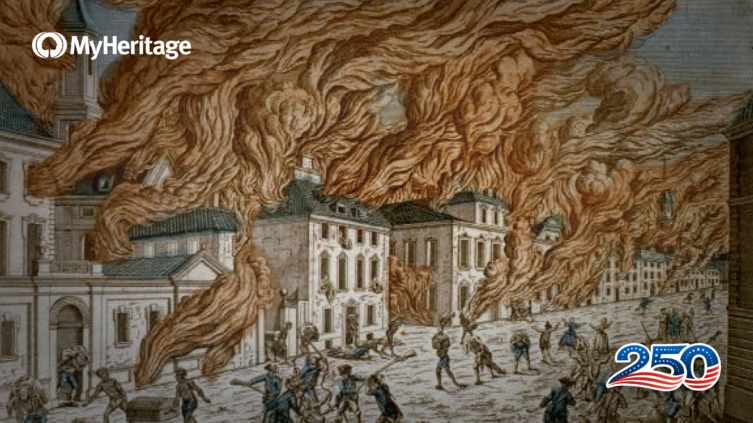
Disaster struck during the late hours of September 20 and the early morning of September 21, 1776. A fire erupted near the Fighting Cocks Tavern near Whitehall Slip and quickly spread across lower Manhattan, driven by strong dry winds and timber-framed structures. Because many firefighters had evacuated the city or taken their equipment, extinguishing the blaze proved extremely difficult.
The fire destroyed between 10% and 25% of the city’s buildings, burning down centuries-old homes, businesses, and landmarks such as Trinity Church. British military commanders suspected Patriot arsonists and arrested hundreds of residents for questioning, though no official proof emerged. The destruction forced thousands of residents into encampments made of canvas tents and wooden huts, known locally as “Canvas Town.”
Tracing your family history in revolutionary New York
The upheaval in New York in September 1776 generated extensive record trails that allow modern researchers to discover their ancestors’ roles. Whether your ancestors served in the military, held Loyalist convictions, or lived through the destruction as civilians, several specific source collections document their lives:
- Revolutionary War Pension Files: Continental soldiers who survived the defense of Manhattan often applied for pensions decades later. These detailed applications describe personal experiences at Kip’s Bay, Harlem Heights, and subsequent campaigns.
- Loyalist Claims and Losses Records: Loyalists who fled to New York or lost property in the Great Fire submitted formal claims to the British government for financial compensation, providing details on family members, former residences, and lost personal belongings.
- Military Service Records and Muster Rolls: British Army muster rolls, Hessian regiments logs, and Continental Army rosters record enlistment dates, hospital stays, casualties, and desertions during the 1776 campaign.
- Church Registers and Property Deeds: Local parish registers of baptisms, marriages, and burials offer vital dates before and after the fire, while land registries track property transfers and post-war land confiscations.
Organizing these findings becomes clear when you construct a family tree to track ancestral lineages across generations.
Combining your lineage with a targeted search across billions of historical records helps locate individual military entries, pension filings, and tax lists.
Furthermore, taking a simple DNA test can connect you with genetic relatives who share descent from colonial New York families, providing new leads for your family history.
To discover more historical insights and explore special resources dedicated to early American history, visit the MyHeritage America 250 site.
FAQs about New York in September 1776
Why was New York City strategically vital in 1776?
New York City offered a centralized location along the Atlantic coastline and a superior deep-water harbor. Controlling the Hudson River allowed the British military to sever communications and troop movement between the New England colonies and the rest of the continent.
Who was responsible for starting the Great Fire of New York?
The origin of the fire remains historically unconfirmed. British authorities accused American sympathizers of setting the fires deliberately, while George Washington and Continental leadership denied ordering the destruction, despite recognizing the city’s strategic value to Britain.
How can I determine if my ancestor was in New York during these events?
You can search digitized military muster rolls, Loyalist compensation claims, town tax rolls, and Revolutionary War pension applications. These documents list residences, military unit movements, and property losses sustained during the autumn of 1776.
The fateful events of September 1776 altered the trajectory of the American Revolution and reshaped the lives of ordinary citizens. Exploring military rosters, compensation claims, and church registers helps bring your ancestors’ experiences during this historic crisis to light.
Yan Sandler is a passionate genealogy enthusiast, specializing in Eastern European and Jewish heritage. He enjoys helping others to uncover their roots, turning complex archival fragments into meaningful family stories for researchers worldwide.