My Ancestor Was Wounded at Gettysburg. The Nurse Who Treated Him Became the Love of His Life


On a sweltering July 2 in 1863, my ancestor Bill Thompson was toiling away on a 36-mile march in the high heat and humidity of a Maryland summer day. Bill was stepping into his destiny.

He had sailed from England to America to fight for the Union Army, joining the Third New York Independent Battery in 1861. They reached the outskirts of the little farming town of Gettysburg, Pennsylvania, amidst a horrific fight around 4 o’clock that afternoon.

Gettysburgh, Pennsylvania, photographed from the west in 1863. Photo colorized and enhanced by MyHeritage
The following morning, July 3, Bill’s battery was moved up to a reserve position behind the front line. They soon found themselves in the midst of a fierce cannonade with the Confederates almost a mile away. Over 200 cannons sent shells tearing through the air, a roar so loud that it could be heard 27 miles away in Carlisle. Two hours later, there was a pause. It was a very brief respite, for out of the woods on Seminary Ridge stepped 15,000 Rebel soldiers, marching straight for Bill’s position. Pickett’s, Pettigrew’s, and Trimble’s Charge had begun. The Pennsylvanians at the Bloody Angle fought hard as the Rebels came on and pierced their line. The attack was ultimately repulsed, but Bill suffered a wound to his upper leg, possibly during that opening cannonade.
Finding love in the midst of war
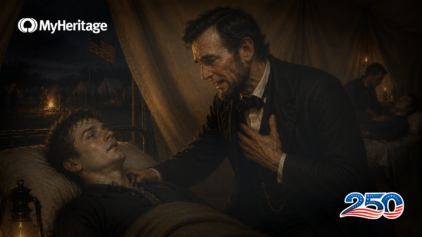
After the 3 days of battle, the town was completely overwhelmed with the wounded. The citizens were mustered into nursing service as most of the local churches and houses became makeshift hospitals. One of those citizens was Margaret Slonaker, who was living in the Adams County Almshouse along with her 7-year-old son, Forrest. The first day’s battle had seen the armies surging back and forth almost on their very doorstep. While nursing Bill back to health, Margaret found herself attracted to the Englishman from Northamptonshire. Little did Bill know that his heart would be stolen away after the carnage of the bloodiest battle of the American Civil War.

AI illustration of Bill recovering under Margaret’s care
Following his recovery, Bill joined the 17th Pennsylvania Cavalry and rode away to fight on. The 17th battled all the way to Appomattox Court House in April of 1865. Afterward, Bill found his way back to Gettysburg and proposed to the light of his life. They married in September 1866 and had 4 children, with Bill informally adopting Margaret’s son, Forrest.
Exploring Bill’s legacy
Margaret passed away in 1897, but Bill lived to be 98 years old. He even took part in the 50th anniversary of the famous battle and was interviewed in his later years by the local newspapers, featured as “Carlisle’s Oldest Citizen” in The Evening Centinel (April 13, 1926), and in Gettysburg’s Star and Sentinel (April 19, 1924). He passed away in 1927. I have copies of his and Margaret’s obituaries in The Evening Sentinel and The Gettysburg Compiler, and he was even featured in a July 1963 edition of The Gettysburg Compiler honoring local citizens who fought in the battle.

Bill is featured in the Gettysburg Times in July 1963
I also have a photo of Bill taken after the war wearing his G.A.R. hat as a member of Captain Colwell Post 201 in Carlisle, Pennsylvania, though unfortunately, I haven’t found a photo of Margaret.

Bill Thompson
No physical artifacts were passed down to my family. Instead, my late cousin, Mildred Riggeal Bucher, spent 30 years researching our family, and her nephew passed her notes on to me. I had to piece the rest of this story together using civil records — including the federal census, marriage and death certificates, and Bill’s Union Army pension records from the National Archives. I also found his service history in the National Park Service U.S. Civil War Soldiers database.

Pension record for Bill Thompson
I was so delighted to find these records, to piece Bill and Margaret’s story together after so much searching, and to share it with my mother and family. I have many, many cousins who now know the personal story of how our forebears met, married, and became a part of such an important event in our nation’s history. We had all wondered about their story, and it has been wonderful to get a glimpse of their romance and the role it played in shaping our family tree. Their story has truly brought history to life for us, giving us a personal connection to the trauma of that momentous event. I can feel that deep connection every single time I visit Adams County, Pennsylvania.

MyHeritage user Susan Alexander
Many thanks to Susan Alexander for sharing her ancestors’ beautiful love story with us. Explore more American Family Stories and discover how ordinary families experienced extraordinary moments in U.S. history on MyHeritage’s America 250 hub.