The Real Uncle Sam: The Family Behind the American Icon


Every American recognizes the image of Uncle Sam: the stern face, the white beard, the star-spangled top hat, and the finger pointing straight at you. But have you ever stopped to wonder where he came from?

Uncle Sam recruitment poster by James Montgomery Flagg, 1917
As the United States approaches its 250th anniversary in July 2026, we set out to revisit the story behind this all-American figure — and how our team traced him back to the real family whose legacy mirrors the nation’s own.
Uncle Sam was not born on a poster or invented by a cartoonist. He was a real human being born in Massachusetts in the 18th century. He lived an industrious life and left behind descendants who still carry his values of service and community today. Through genealogical research, MyHeritage helped bring his story full circle: from myth to man, and from history book to living memory.
The full story of how MyHeritage uncovered the real Uncle Sam — and traced his living descendants — is told in the Blast From My Past podcast episode below:
Confirming Uncle Sam’s identity
The familiar Uncle Sam image took shape in the late 19th and early 20th centuries, solidified by political cartoonist James Montgomery Flagg. His version — resolute, human, and unmistakable — became a national symbol, especially during wartime.
But historians had long suspected that the name itself pointed to a real person.
A simple search surfaced one theory again and again: a man named Samuel Wilson, who worked as a government supplier during the War of 1812. The research team turned to historical records and quickly found confirmation.
What followed was classic genealogical work: building a family tree, generation by generation, and following it forward until it reached living descendants.
The man behind the name
Samuel Wilson was born on September 13, 1766, in Massachusetts, the fifth of 13 children. His grandfather had settled in New England and bought farmland in 1665, more than a century before Samuel was born. Like many early Americans, Wilson moved often, and he eventually settled in Troy, New York.
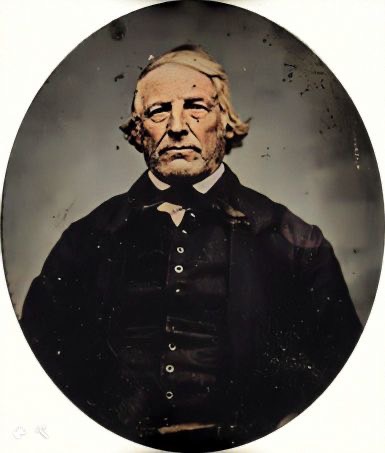
Samuel Wilson
There, he became a respected entrepreneur and community figure. He worked as a brick mason and farmer, owned a distillery, and in 1793 opened a butcher shop with his brother. By the time the War of 1812 broke out, Wilson employed more than 100 people, many of whom already called him “Uncle Sam.”
When the U.S. Army needed supplies, Wilson was contracted to provide meat. The barrels were stamped “U.S.” for United States, alongside the initials of the government contractor. Soldiers, many of whom knew the Wilson family personally, began joking that the food came from “Uncle Sam.”
The nickname stuck. And it spread.
Though Samuel Wilson did not live to see his name become a national symbol, by the time of the Civil War, Uncle Sam had become a unifying figure representing the nation itself.
Finding the family
Tracing Samuel Wilson’s descendants was not simple. Starting with a name shared by countless men in early America meant moving cautiously, generation by generation, checking each record and relationship to be sure the trail truly belonged to the man behind Uncle Sam.
Census after census, obituary after obituary, the line eventually led to Arkansas — to a woman named Helen Hauptmann Painter.
For Helen, the discovery was not a revelation, but a confirmation.
“I’ve always pretty much been aware of the connection to Samuel Wilson,” she said. “My grandmother was the daughter of Carlton Sheldon, who was Marion Wilson’s son, and she was the granddaughter of Samuel. Granny always kept us very informed.”

Left: Helen as a young girl. Right: Helen’s grandmother, also named Helen
Family Bibles, baby books, and carefully preserved records had kept the story alive long before digital archives existed.

An entry from Granny Helen’s baby book, where her grandmother Marion Wilson Sheldon wrote that she is the great-great-granddaughter of Uncle Sam
A legacy of service
Helen grew up in a large Catholic family in Conway, Arkansas, where stories of Uncle Sam occasionally spilled into public life, from school projects to county fair parades.
“I remember in the 1980s Granny contacted our local fair committee and we rode in the county fair parade as the only living descendent of Uncle Sam,” she remembers. “We rode behind Jerry Lee Lewis, as best I recall.”
For Helen, Uncle Sam was never just a national symbol. He was a working man who provided for others and served his community, and that example shaped how her family understood who they were and how they should live. Helen carried that legacy into her own life as a registered nurse, just as her son Trey did through his military service.
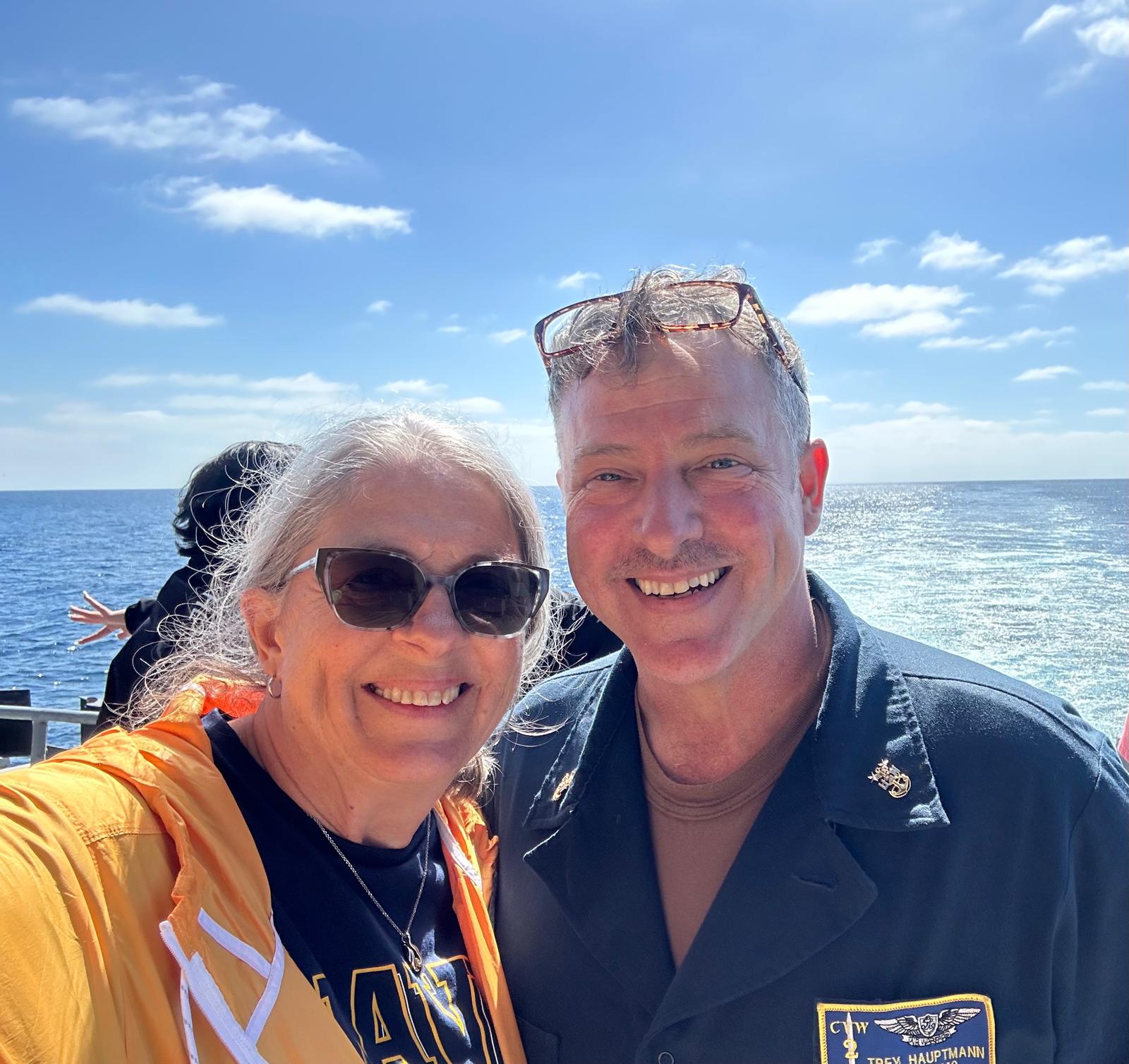
Helen with her son Trey
Trey Hauptmann, a 20-year Navy veteran and senior chief petty officer, keeps an iconic Uncle Sam poster hanging in his office. It makes him smile every time he sees it.
“It says ‘I want you to join the U.S. Army,’ and here I am in the Navy,” he says with a chuckle. But the image also reminds him of the man behind it — and the responsibility that comes with the name. He mentioned to Helen that while Uncle Sam supplied the army with the meat and pork they needed, he provides them with Band-Aids they need. “So in some ways Samuel Wilson has influenced his belief in assisting people and helping people,” she says.
Walking in Uncle Sam’s footsteps
Years later, stationed in Newport, Rhode Island, Try finally made the trip his mother had long encouraged to Troy, New York.
He visited Samuel Wilson’s grave, walked the streets where his ancestor once worked, and saw Uncle Sam’s image painted on buildings throughout the city. He even stopped for a drink at a local brewery bearing the family name.
“To know Uncle Sam used to actually walk these streets the same as I’m doing right now,” he reflects, “it made everything feel real.”
America at 250 and the stories that bind us
As the United States prepares to mark 250 years since its founding, the story of Uncle Sam serves to remind us that national history is built from individual lives: from farmers, butchers, business owners, nurses, and service members whose stories intertwine across centuries.
What emerged from the research was not only the survival of Samuel Wilson’s bloodline, but the persistence of his values. Generations later, his descendants continue to serve their country and communities, and to carry forward a deep-rooted sense of patriotism and public responsibility.
For the MyHeritage Research team, uncovering the real Uncle Sam reinforced a belief they return to again and again: that every family’s history matters.
Sometimes, the story is right on the surface. Sometimes, you have to dig deep enough to uncover it. And sometimes, hidden behind an icon, you find a man whose legacy still lives, 250 years into the American story.
Daniella Levy is the Senior Copywriter and Content Manager at MyHeritage with years of experience creating content that helps people explore their family history. Through her work on hundreds of articles, blog posts, video scripts, and user education materials, she has developed deep familiarity with genealogical research tools, historical records, and the challenges and joys of family history discovery. Daniella draws on her background in creative writing to make genealogy more accessible, engaging, and meaningful for MyHeritage users worldwide. She is also the author of 3 books.