A Son Lost at Gettysburg, Preserved in a Haunting Photograph


In 1863, my husband’s great-great-grandfather James Fulton Hoge and his wife, Eliza, welcomed their ninth child, Beverly Lacy Hoge. Yet even as new life entered their home, the realities of war cast a long shadow. Two years earlier, their eldest son, Andrew Johnston Hoge, had enlisted in the Confederate Army at age 18, viewing his service as an adventure into the wider world.

Andrew served in the Stonewall Brigade under Brigadier General James Walker and was known as a skilled sharpshooter. By June 1863, after nearly two years of service, he had been promoted to corporal. As his regiment marched north into Pennsylvania, neither Andrew nor his family could have known how profoundly the coming battle would shape their lives.
The Battle of Gettysburg
The Battle of Gettysburg, fought over three days in July 1863 in and around Gettysburg, Pennsylvania, would become one of the most significant turning points of the Civil War. More than 50,000 soldiers were killed, wounded, captured, or missing, making it the bloodiest battle of the war. While its national impact is well documented, for the Hoge family it became a deeply personal tragedy.
On July 1, 1863, Confederate forces under General Henry Heth advanced toward Gettysburg in search of supplies but unexpectedly encountered Union cavalry. What followed was an unplanned but fierce engagement. Despite intense heat and heavy fighting, Confederate forces eventually pushed Union troops through the town and onto Cemetery Hill.

Battle of Gettysburg by Thure de Thulstrup, 1887
The second day of battle saw Union forces entrenched along a defensive line shaped like a fishhook across the hills and ridges south of Gettysburg. Although Confederate troops gained ground at both ends, the Union position held as night fell.
On the third day, General Robert E. Lee ordered a direct assault on the Union center at Cemetery Ridge. This attack, known as Pickett’s Charge, proved devastating. Of the 12,500 Confederates who advanced, casualties approached 60%, and only one brigade briefly reached the ridge. Simultaneously, heavy fighting continued at Culp’s Hill, while cavalry engagements unfolded to the east and south.
Comfort from a cousin in his final moments
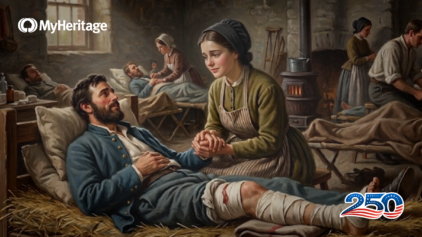
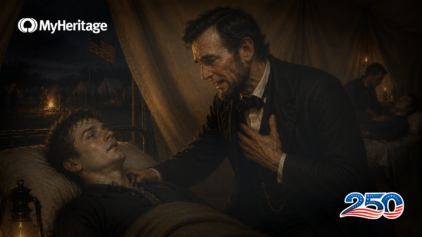
After the battle, according to our family’s history, Andrew sought shelter in an area known as Devil’s Den alongside fellow soldiers, including his cousins. While resting against a stone wall with his weapon in hand, a stray bomb fell and exploded in his lap. The blast killed or scattered those nearby. Only his cousin, Captain John Thomas Howe, remained. Despite his own injuries and the danger surrounding him, John retrieved water from a nearby stream, placed a blanket beneath Andrew’s head, and stayed with him until he passed, receiving his final words and closing his eyes in death.
John’s brother, Samuel Shepherd Howe, was also present that day. Both men were captured by Union forces. Captain John Howe was sent to a hospital, sparing him the harsh conditions of Point Lookout, Maryland, where Samuel later died.
The photograph from Devil’s Den
Andrew’s body remained among the fallen in the field. According to the Hoge family’s history, Andrew’s body was photographed in Devil’s Den after the battle. The image was later published in the Review of Reviews and subsequently in Photographic History of the Civil War, accompanied by the caption: “Whatever the results of the war, for this fine manly young Southern boy, it is over.” It was Governor James Hoge Tyler who later identified Andrew from the photograph.
Editor’s note: The following historical photograph depicts a deceased soldier.

The famous photo of the Civil War soldier the Hoge family identified as Andrew, titled Home of a Rebel Sharpshooter by Timothy O’Sullivan
According to the family’s records, formal identification came in 1864, when Dr. Moses Drury Hoge recognized Andrew’s remains during the reburial of soldiers at Hollywood Cemetery, using documents found in his pockets.
Emotional and financial scars
The loss profoundly affected Andrew’s father. In the wake of his son’s death and following the nearby Battle of Cloyd’s Mountain, James Fulton Hoge enlisted in 1864 at the age of 46. He joined the 4th Regiment Virginia Reserves, known as Preston’s Reserves, a unit composed largely of men over 45.
After a year of service, James returned home. During his absence, his wife and younger children maintained the family farm. Their eldest daughter, Anne, age 23, and son Robert, age 13, likely played critical roles in sustaining the household, even as many farms were stripped of resources by passing Union troops.
The devastation experienced by the Hoge family reflected a broader reality. Confederate families across the South endured immense loss not only of loved ones but also of economic stability. Many lost primary providers, and communities struggled to rebuild amid widespread destruction and grief. The emotional and financial scars of Gettysburg and the war lingered for generations.
In the aftermath of the war, James Hoge, having served as a Confederate officer, was required to pledge loyalty to the United States. As a result, he lost both his voting rights and his law practice. Already burdened by the loss of his son and the decline of his farm, he now faced the challenge of rebuilding his life during Reconstruction.
More than 160 years later, Andrew’s story remains an important part of the Hoge family’s history. Today, I am honored to help preserve that legacy from Belle Hampton, the family’s historic Virginia home, where generations of the Hoge family have lived and safeguarded their stories.

Tom and Madeline Hoge, who currently live on and manage the Hoge family’s historic estate
Many thanks to Madeline Hoge for sharing her family’s heartbreaking story with us. Explore more American Family Stories and discover how ordinary families experienced extraordinary moments in U.S. history on MyHeritage’s America 250 hub.