‘I Love You, My Brother’: How a DNA Discovery Closed a 70-Year Circle Before My Brother’s Final Goodbye


In August 2018, I was at home in Milo, a small town on the slopes of Mount Etna in Sicily, when I received the results of a DNA test I had taken through MyHeritage.
Like many people, I was curious about my family origins. I expected to learn more about my ancestry and perhaps connect with distant relatives.
Instead, I discovered that I had a brother I never knew existed.
When I opened my DNA matches, the first result immediately caught my attention. According to MyHeritage, a man living in the United States was my half-brother.

Angelo’s match to a half-brother in the U.S.
I was 60 years old at the time. I already had brothers and sisters. As far as I knew, there were no family secrets.
I couldn’t believe what I was seeing.
I called my wife, Adriana, and showed her the results. Then I called my brothers. We were all shocked. We tried to think of an explanation, but none of us could understand how such a thing could be possible. As far as we knew, there was no missing branch of our family. My father, Pippo, had died years earlier. He had married my mother and raised our family in Sicily. He had never mentioned another child, and none of my brothers or sisters had ever heard anything that suggested otherwise.
But the match was too close to ignore.
I decided to contact him.
The first messages
The man was called Carlo Arco and lived in Connecticut.
I sent him a message through MyHeritage, introducing myself and asking whether he knew anything about his biological family.
His reply raised even more questions.
Carlo explained that he had been adopted. He had been born in Turin in 1952 — before my father married my mother — under the name Giancarlo Lavi. He knew very little about his origins and had spent most of his life searching for answers.

The Italian passport issued to Giancarlo Lavi in 1956
Shortly after his birth, he was placed in a religious institution. He spent the first years of his life there. At the age of 5, he was sent alone to the United States, where he was adopted by an American family.
As we exchanged messages, it became increasingly clear that the DNA results were correct.
We arranged a video call.
It is a moment I will never forget.
When the call began, Carlo was overcome with emotion. He struggled to speak. Both of us were trying to process what was happening. After nearly 70 years, two brothers who had never known each other were finally meeting.
When he was finally able to speak, his words were simple and direct.
“I love you, my brother.”
Those words marked the beginning of a relationship that quickly became very deep. The more I listened to his story, the more strongly I felt that I had a responsibility to help him find the truth. I knew we must be related through my father Pippo, but that was only half of the story. Who was Carlo’s mother, and why had she abandoned him? With my father gone, there was only one way to find out: research.
Searching for Carlo’s mother
For nearly two years, I examined civil records, church archives, municipal registries, and historical documents. I traveled to Turin and contacted institutions connected to Carlo’s early life. I followed every lead I could find.

A record on MyHeritage of Carlo’s 1958 arrival in the U.S.
Little by little, the pieces began to come together.
Eventually, I identified Carlo’s mother.
Her name was Filomena.

Carlo’s biological mother, Filomena. Photo colorized and enhanced by MyHeritage
The story that emerged was very different from the one Carlo had believed for most of his life.
A different truth
For decades, Carlo believed that he had been abandoned because he was unwanted.
The documents and testimonies I uncovered told another story.
Filomena was a young woman living in post-war Italy, a time when social conventions and religious pressures could be unforgiving. An unmarried pregnancy often carried enormous stigma.
As I continued my research, I came to understand that she had been caught in circumstances that left her with very few choices.
I located her grave and was able to reconstruct much of her life. I also contacted relatives connected to her family and gathered information that helped fill in many of the missing details.
The more I learned, the more convinced I became that she had never forgotten her son.
For me, this was one of the most important discoveries of the entire journey.
Carlo had spent almost 70 years believing that he had been rejected.
The truth was far more complicated and far more human.
Meeting in person
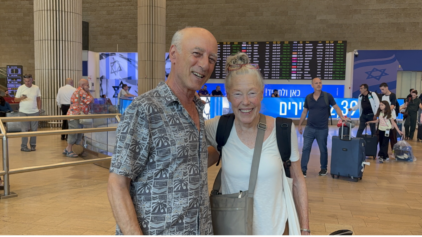
In April 2019, my son Marco and I traveled to the United States to meet Carlo and his family.
After months of messages and video calls, we finally embraced in person.

Angelo and Carlo share their first hug
It was an extraordinary experience.
Although we had grown up on opposite sides of the Atlantic and lived completely different lives, there was an immediate sense of familiarity between us.
I also met his wife, Debra, who had been by his side through many difficult years, and his family welcomed us warmly.

Angelo (center) with Carlo and Debra
Our relationship continued to grow over the following years. We remained in regular contact and shared many conversations about family, history, and the discoveries we were making together.
In 2022, I returned to visit him again.
By then, we both understood how precious our time together was.

Angelo and Carlo during Angelo’s second visit
The final goodbye
Carlo had faced many health challenges throughout his life.
In his later years, his condition became increasingly serious. Despite everything, he remained grateful that we had found one another.
In November 2023, I learned that he was nearing the end of his life.
I spoke to him one last time.
Even in those final moments, he recognized my voice.
His last words to me were the same words he had spoken during our first video call years earlier.
“I love you, my brother.”
Shortly afterward, he passed away.

Angelo and Carlo
Preserving Carlo’s story
After Carlo’s death, I felt an even greater responsibility to preserve what we had discovered together.
Our story is not only a family story. It is also part of a larger history involving children who were separated from their families and sent abroad during the post-war years.
To document everything we uncovered, I wrote a book titled Lavi: Figlio di Nessuno (now available also in English as Lavi: Nobody’s Child). The book tells the story of Carlo’s life, our discovery through MyHeritage DNA, the search for our mother, and the long investigation that helped us understand what had happened.

The English edition of Angelo’s book
Today, when I think back to that day in August 2018, I still find it difficult to believe that a simple DNA test could uncover so much.
What began as a search for family origins led me to a brother I never knew existed.
Most importantly, it gave Carlo answers that he had been searching for his entire life.
And it allowed two brothers, separated for nearly 70 years, to finally find each other.
Many thanks to Angelo for sharing this incredible and heartbreaking story with us. If you’ve also made an amazing discovery with MyHeritage, we’d love to hear about it. Please send it to us via this form or email us at stories@myheritage.com.