Tracing Irish Ancestors: A Guide to Famine-Era Genealogy


The Great Famine, often called the Irish Potato Famine, reshaped Ireland and the lives of millions of people across the world. Between 1845 and 1852, the failure of the potato crop led to mass hunger, disease, and emigration. During those years, about 1 million people died and millions more left Ireland in search of a new life. Today, descendants of those emigrants live across the United States, Canada, Australia, the United Kingdom, and beyond. Many are exploring their Irish roots and asking an important question: how can you trace an ancestor who left Ireland during the famine years? With digitized historical records and modern genealogy platforms like MyHeritage, researching Irish family history is easier than ever.
Irish genealogy after the Great Potato Famine
The famine permanently changed Ireland’s population and created one of the largest migrations in modern history.
Key facts include:
- The timeline: The Great Famine occurred between 1845 and 1852, though its social effects lasted decades.
- The great migration: Around 1 million people died and more than 1.5 million emigrated.
- Irish immigration: By 1850, Irish-born residents made up roughly 43% of the foreign-born population in the U.S.
- Global diaspora: Today, the Irish diaspora is estimated at about 70 million people worldwide, with most of them residing in English-speaking countries.
- Cultural legacy: St. Patrick’s Day celebrations in the U.S. became a powerful symbol of Irish identity.
For many families, tracing ancestors from this period begins with organizing known relatives and building a family tree.

A famine cottage in Athea, County Limerick as it stands today
The Young Irelanders rebellion and Thomas Francis Meagher
The years following the famine also saw political upheaval in Ireland. One important event was the Young Irelanders Rebellion of 1848, a short-lived uprising inspired by revolutionary movements across Europe. Although the rebellion in County Tipperary was quickly suppressed, it had lasting political significance. Many of its leaders were exiled and later influenced Irish communities abroad. One notable figure was Thomas Francis Meagher. After participating in the rebellion and the Battle of Ballingarry, Meagher was sentenced to death. The sentence was later commuted, and he was transported to Australia. He eventually escaped and traveled to the United States in 1852, where he later became a Union general during the American Civil War and served as acting governor of Montana. Stories like Meagher’s highlight how Irish migration shaped the political and cultural history of many countries.

Record of Thomas Meagher in United States Civil War Draft Registration, 1863-1865 collection on MyHeritage
Researching Irish ancestry outside Ireland
Tracing famine-era ancestors can be challenging because many Irish records from the nineteenth century were incomplete or lost. However, research is often successful when it begins in the country where an ancestor settled.
Today, genealogists rely heavily on digitized historical records to track migration, census entries, and immigration documents. These records can reveal valuable details such as:
- Occupations
- Names of family members
- Places of birth
- Immigration dates
Together they help researchers reconstruct the journeys of Irish emigrants.

The Irish Famine Memorial in Sydney is dedicated to the 4114 young Irish women who arrived in Australia from 1848 to 1850 under the Earl Grey assisted emigration scheme
The United States: building a new nation
The United States became the primary destination for people fleeing the Great Irish Famine. Between 1845 and 1855, more than 1.5 million Irish immigrants arrived in American ports. Their contributions shaped the development of cities, industries, and communities across the country.

Depiction of ship preparing to sail from Ireland to America during the Irish Famine
Several types of records are particularly valuable for Irish genealogy research in the United States:
- Passenger lists: Beginning in 1820, ship captains were required to file passenger lists with U.S. customs officials. These records provide names, ages, occupations, and ports of origin.
- Castle Garden and Ellis Island records: These collections contain millions of immigration records for people arriving in New York between the nineteenth and early twentieth centuries.
- U.S. census records: The 1850 U.S. census was the first to list every person in a household and record each individual’s birthplace — a critical detail for identifying Irish immigrants. For the 1790 Census through the 1840 Census, only the name of the head of household was collected, which can also be useful if the family name is known.
- Newspapers and local histories: Historical newspapers often contain obituaries, community announcements, and reports of Irish organizations that can provide clues about family origins.
United Kingdom records for Irish immigrants
As Ireland was still part of the United Kingdom until 1922, many Irish emigrants first traveled to Great Britain before moving elsewhere. During the famine, migration between Ireland and Britain was considered internal movement within the United Kingdom, so passenger lists were rarely recorded.
Despite this limitation, several sources remain useful:
- England and Wales census records
- Civil registration indexes for births and marriages
- Local parish records
The 1851 England and Wales Census recorded approximately 466,000 Irish-born residents in England and Wales, illustrating the scale of migration during that period.
Canadian records for Irish famine immigrants
Canada was another major destination for Irish emigrants during the famine years.
In 1847, the Port of Québec was overwhelmed with ships carrying thousands of refugees. Many immigrants were quarantined on Grosse-Île, which later became one of the largest Irish burial sites outside Ireland.
Useful Canadian genealogy resources include:
- Canada immigration and naturalization records
- Canadian census records
- Canada land and government records
- Digitized historical newspapers
These sources can help identify where immigrants settled and how families moved within Canada.

A poster advertising the sailing of the Superior from Derry to Quebec in July 1847
Australian records for Irish famine immigrants
Although smaller in number than those traveling to North America, many Irish emigrants also settled in Australia. Between 1848 and 1850, more than 10,000 Irish immigrants arrived in Sydney, Port Phillip, and Moreton Bay.
In addition to those immigrants, over 40,000 Irish prisoners, around 24% of the 164,000 total, were sent to Australian penal colonies between 1791 and 1868, often for crimes motivated by political uprising or poverty. The main destinations for these men and women were Van Diemen’s Land (today’s Tasmania) and New South Wales. Despite their difficult labor, several of them achieved success after being set free.
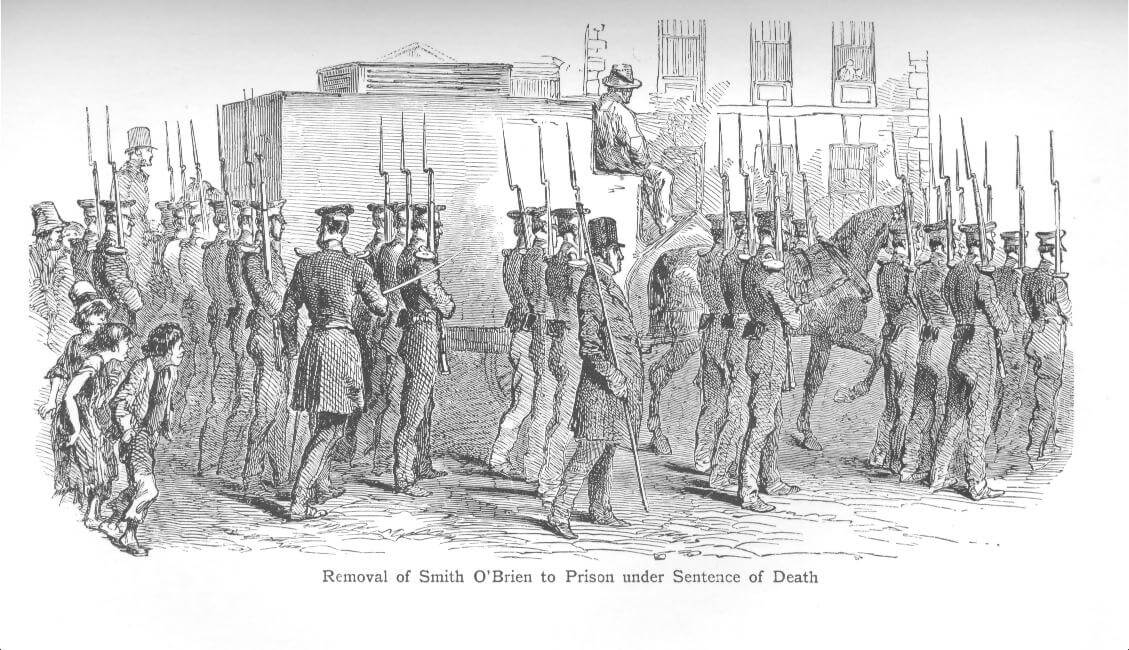
Removal of one of the leaders of the rebellion to prison, following his trial. A death sentence was later changed to transportation to Van Diemen’s Land.
Key sources for Australian research include:
- Assisted and unassisted immigration records
- Death indexes and gravestone inscriptions
- Transportation records for Irish convicts
These documents can reveal birthplaces in Ireland, family relationships, and migration routes.
How to start researching Irish famine ancestors
If you are looking to learn more about an ancestor who left Ireland during the famine era, these steps can help you begin your research.
Step 1: Build a family tree
Start by collecting information from relatives, family documents, and photographs. Recording these details in a family tree helps organize relationships and identify missing information.
Step 2: Search immigration and census records
Passenger lists, census records, and naturalization documents can reveal when your ancestor arrived and where they settled.
Step 3: Explore MyHeritage historical records
MyHeritage provides access to billions of historical records and advanced matching technologies that help connect documents to your family tree. Features such as Record Matches and Smart Matches™ automatically identify relevant records and relatives that may expand your research.
Step 4: Trace Irish parish and civil records
Once you identify a likely birthplace, Irish civil registration records, parish registers, and local archives can help confirm earlier generations.
You can also explore the origins of common Irish surnames and their historical meanings here on the MyHeritage Wiki.
From hardship to heritage: the legacy of St. Patrick’s Day
It is often said that St. Patrick’s Day as we know it was “made in America.” What began as a solemn religious feast in Ireland transformed in the U.S. into a defiant, powerful, and proud display of cultural identity. In the face of 19th-century “No Irish Need Apply” discrimination, parades and community celebrations became a way for our ancestors to claim their space in American society.

Postcard postmarked 1912 in the United States
Today, when we wear green every March 17th, we honor not only the saint, but also the resilience of those who survived the Gorta Mór (the Great Hunger) to build new lives, families, and a future in the United States.
Are you ready to find your place in America’s 250-year history? Use these records to discover the names of the brave men and women who carried their Irish spirit across the Atlantic.
Summary
Researching Irish ancestors from the famine era may seem difficult, but new discoveries are made every day. Digitized historical records, census documents, immigration lists, and newspaper archives continue to reveal new details about the lives of Irish emigrants wherever they settled around the world. With patience and the right resources, you can uncover the journeys of the people who carried their Irish heritage across oceans and generations.
FAQs about Irish genealogy
How do I find out which part of Ireland my ancestors came from?
Start with immigration, census, and naturalization records in the country where your ancestors settled. These documents often include a county or townland in Ireland.
Were many Irish genealogy records destroyed?
Yes. A fire at the Public Record Office in Dublin in 1922 destroyed many historical documents. However, alternative sources such as church registers, newspapers, and civil registrations can still help reconstruct family histories.
Why is St. Patrick’s Day relevant to genealogy?
Historical newspaper accounts of parades and Irish community organizations often mention specific families and hometowns in Ireland, providing useful clues for researchers.
What if my ancestors emigrated after the famine?
Irish emigration continued well into the late nineteenth and early twentieth centuries. Passenger lists, census records, and civil registration records remain valuable sources for tracing those later migrations.
Where will your family history research take you next? The story of Irish migration is also a story about individual families — and your ancestors may be waiting to be discovered in the historical records of the past.
This guest post has been written by Ireland Reaching Out. Every year, Ireland Reaching Out helps thousands of people who are tracing their ancestors who immigrated during the Irish famine. The goal is to reconnect everyone of Irish heritage with their place of origin in Ireland and the community living there today. To learn more about Ireland Reaching Out, visit www.irelandxo.com.