The California Gold Rush: Facts and Myths

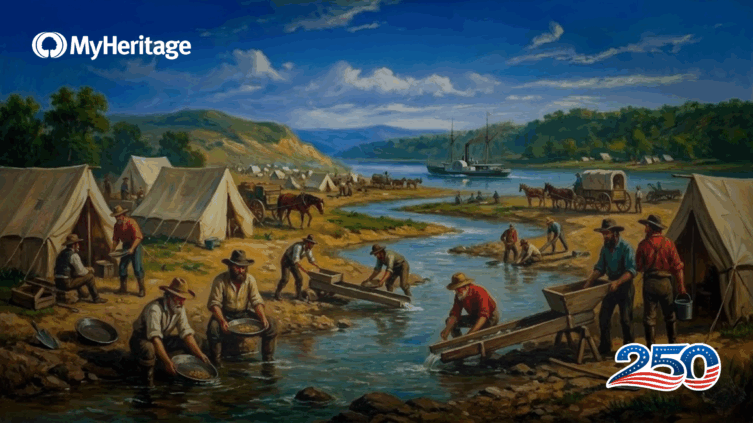
The California Gold Rush is one of the most significant moments in American history, leading to one of the country’s largest influxes of mass migration that reshaped the West Coast, and changed the fortunes of thousands of families. There are plenty of misconceptions about the California Gold Rush, with many of them reinforced by Hollywood movies.

In this article, we’re separating fact from myth by exploring the California Gold Rush and how it affected the lives of everyday people. At MyHeritage, you can explore a range of historical documents related to the Gold Rush. If you’re tracing your family tree to the West Coast of the United States during the late 1840s to 1850s, you’ll want to learn more about his historic event and its potential impact on your ancestors.
Key takeaways on the Gold Rush
- The California Gold Rush saw an influx of mass migration to the West Coast after gold was found in Sutter’s Mill in early 1848. More than 300,000 people are estimated to have come to California during the Gold Rush.
- Before the Gold Rush, most of California’s 160,000 occupants were Native Americans, but by the mid-1850s, the state’s demographics had drastically changed with immigrants from across North and South America, along with China and Europe.
- Although Hollywood has romanticized the era of the Gold Rush, only a lucky few got rich. Many people experienced instability, financial hardship, and long-term displacement as a result of the Gold Rush.
- While the Gold Rush lasted for less than a decade, it led to the creation of extensive records, which are valuable for genealogical research and tracing your ancestors during the late 19th century.
- You can use MyHeritage’s historical records and features like Smart Matches™ to uncover your family’s connection to the Gold Rush era.
What sparked the California Gold Rush?
The California Gold Rush began after gold was discovered at Sutter’s Mill in January 1848. While the news of the discovery spread slowly at first, it eventually became more widespread. While there were 4,000 gold miners in the Coloma area of California in August 1848, there were estimated to be 80,000 of them within a year. Attracted to the area by the promise of riches, California’s population would eventually hit up to 300,000 people, with an estimated value of $2 billion of gold being extracted.
It’s important to remember that the Gold Rush hit its peak in 1852 and was considered to be over by the end of the decade. The high price of gold and harsh working conditions meant that only a select few were able to make major financial gains from the Gold Rush. The shift from individual mining to organized operations led by companies resulted in many immigrants transitioning to farming.
The Gold Rush is significant politically, economically, and culturally to California and the wider United States. It drastically changed the state’s demographic and led to the establishment and expansion of several towns and cities, including San Francisco.
The people of the Gold Rush: Who came to the west coast and why
American migrants who moved to California from the East Coast and Midwest became known as the “Forty-Niners,” a reference to the first major year of immigration during the Gold Rush. International immigration to California during this time is often overlooked, but many people traveled from Australia, Europe, China, and Latin America on the promise of finding gold.
Many of these immigrants, including women and families, struggled under the reality of the Gold Rush. Indigenous communities also saw their lives disrupted with the loss of ancestral lands and an increase in violence, resulting in forced displacement.
California Gold Rush: Hollywood myths vs. historical reality
Many popular myths about the California Gold Rush have been enhanced by Hollywood movies like Paint Your Wagon, The Gold Rush, Pale Rider, and The Sisters Brothers.
Common myths include the assumption that most miners became wealthy as a result of the Gold Rush. In reality, the majority of them struggled financially or lost money. A similar myth is that only miners financially benefited from the Gold Rush. In fact, railway businesses, merchants, and landowners benefited financially from the Gold Rush more than the miners themselves.
While the myth that the Gold Rush was brief is technically correct, its social and economic impact was felt for decades and laid the foundations for what California would become. It’s another myth that most immigrants to the area lived in the frontier, when in reality, many of them settled permanently with their families, forming towns that still exist today.
How the Gold Rush shaped family histories
The Gold Rush shaped family dynamics and histories for generations, with this sudden influx of migration having a drastic impact on the lives of Native Americans and the miners who came to California with their families. Temporary structures that were created to support these miners eventually evolved into permanent settlements, including towns and cities.
After failing to make their riches in the Gold Rush, many miners changed their occupation, becoming farmers, railroad workers, and merchants instead. The Gold Rush also played a significant role in California becoming recognized as a state in 1850, just two years after the discovery of gold at Sutter’s Mill. The establishment of California as a state led to an increase in official records and documents, making it easier to trace your family tree.
Trace your family tree with MyHeritage’s historical records
The California Gold Rush changed the West Coast of the United States, while reshaping the lives of thousands of families and having a devastating impact on indigenous communities. Separating fact from myth is the first step to understanding the Gold Rush and how it might have impacted your ancestors. Learn about your family’s connection to the California Gold Rush by joining MyHeritage today and getting instant access to billions of historical records.
FAQs about the California Gold Rush
Did most Gold Rush miners actually find gold?
Most miners earned very little or even nothing from mining during the Gold Rush, due to poor working conditions and the high price of gold.
How can I tell if my ancestor participated in the Gold Rush?
If your ancestor migrated to California from 1848 to the late 1850s, they likely participated in or were impacted by the Gold Rush.
Are there specific records for miners from the California Gold Rush?
The Gold Rush created a range of official records, from mining claims to tax lists and newspaper reports.
What if my ancestor wasn’t a miner but lived in California during the Gold Rush?
It was often other laborers, railway workers, and merchants who came out better from the Gold Rush, and they also appeared in property and census records.
Can DNA testing help connect me to Gold Rush-era families?
DNA testing can help you find new relatives through shared DNA and unlock new aspects of your family tree.