











I wonder if we will EVER know what happened to them?
Amelia Earhart: American Aviation Pioneer

American aviator Amelia Earhart, born on July 24, 1897, disappeared on July 2, 1937, over the central Pacific Ocean near Howland Island.

Amelia Earhart came from a mix of German and English roots. Her father, Samuel “Edwin” Earhart, worked as a lawyer for the Rock Island Railroad, while her mother, Amy Otis, came from a prominent New England family with deep colonial roots. Amelia’s maternal grandfather, Alfred Otis, was a respected judge and president of the Atchison Savings Bank. Despite this privileged lineage, Amelia’s home life was unstable. Her father struggled with alcoholism and job loss, and the family moved frequently during her childhood.

Amelia Earhart, age 7, appears alongside her mother, Amy, and younger sister, Muriel, in the 1905 Kansas State Census. Source: MyHeritage
Even as a young girl, Amelia was curious, independent, and drawn to adventure. She built her own makeshift roller coaster in the backyard with help from an uncle and kept a scrapbook filled with newspaper clippings about women succeeding in fields like science and law. Though she first saw an airplane at the Iowa State Fair in 1908, she wasn’t impressed at the time.
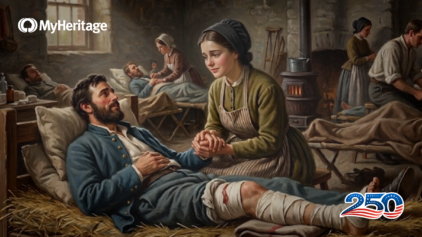
In 1917, Amelia’s sister Muriel Earhart was studying at Saint Margaret’s School in Toronto when Amelia came to visit — and decided to stay. Wanting to contribute to the war effort, Amelia took a job as a nurse’s aide at the Spadina Military Hospital, where she cared for wounded soldiers returning from the front. Toronto at the time was known as “the undeclared capital of flying in the British Empire,” and the Earhart sisters found themselves surrounded by military pilots and early aviation activity. It was during this period that Amelia’s interest in flight began to take shape. “The interest aroused in me in Toronto led me to all the air circuses in the vicinity,” she later told reporters — an early spark that would soon grow into a lifelong passion.
In 1920, she took a brief ride in a biplane in California. That sealed her decision to become an aviator.

Amelia appears in the 1930 U.S. census. Her occupation is listed as “Flyer-Writer” in the “Aviation-Magazine” industry. (click to zoom)
Amelia worked as a clerk at a telephone company and a photographer to pay for flight lessons. Her first instructor was Anita “Neta” Snook, who taught her in a Curtiss Jenny at Kinner Field in Los Angeles. Amelia piloted her first solo flight in 1921, and then bought her first plane, a Kinner Airster. She hadn’t even earned her pilot’s license yet when, in 1922, she broke the women’s altitude record for flying above 14,000 feet. She became the 16th woman to receive an official Fédération Aéronautique Internationale pilot license in 1923.
Below is a LiveMemory™ animation of a photo of Amelia from July 14, 1928, standing in front of her bi-plane named Friendship in Newfoundland:
In 1928, she became the first woman to be flown across the Atlantic Ocean and in 1932 she became the first woman to fly solo across the Atlantic. That same year, she received the Distinguished Flying Cross and the Gold Medal of the National Geographic Society.

Amelia’s first transatlantic flight covered extensively on the front page of the Greensburg Daily Tribune on June 18, 1928 (click to zoom)
In July 1937, Amelia was attempting to complete a round-the-world tour on a twin-engine Lockheed Electra with navigator Fred Noonan, when they lost radio contact. A dozen ships and 50 aircraft, from the US government, searched for them for several months. Nothing of significance has ever been discovered about their whereabouts and Amelia, then 41, was officially declared dead on January 5, 1939.

An article from The Spartanburg Weekly Herald and Herald Journal with updates about the search for Amelia, July 20, 1937. Source: OldNews.com
There are many conspiracy theories surrounding Amelia’s disappearance. Some suggest that the flight was actually a spy mission commissioned by Franklin D. Roosevelt; others suggest that they were captured by the Japanese. There is even a theory that Amelia survived the flight and returned to the US, assuming another identity. Most believe that the plane crash-landed and that Amelia and Fred perished in the crash or shortly after.


More than 75 years later, the mystery continues — but as of July 2025, it appears closer than ever to being solved. Researchers from the Archaeological Legacy Institute, in partnership with Purdue University, have announced a forthcoming expedition to Nikumaroro Island in Kiribati. This initiative is driven by satellite imagery from 2015 that appears to show a portion of Earhart’s Lockheed Electra 10E protruding from the island’s sand. The expedition, set for November, aims to investigate this potential lead, with hopes of finally uncovering evidence of Earhart’s fate.
Though Amelia Earhart had no children of her own, her younger sister Muriel — often her closest confidante — carried on the family line. Muriel and her husband Henry Morrissey had two children: David, who passed away in 1978 and left descendants of his own, and Amy Morrissey Kleppner, a longtime educator and civic leader who lived in Maryland and Vermont. Through them, Muriel became grandmother to several grandchildren who today live across the United States, including in California, Massachusetts, and Vermont. Muriel herself was a key figure in preserving Amelia’s memory: she spent decades promoting her sister’s legacy, speaking out against unfounded rumors, and eventually publishing a biography titled Amelia, My Courageous Sister. Today, with her descendants still keeping Amelia’s story alive, museums, scholarships, and even airports bear Amelia’s name — a lasting tribute to her trailblazing role in aviation and her impact on generations of women who followed.

barbra
August 1, 2012
wow!