From 1637 to America 250: A 400-Year Legacy Proven in Ink and Parchment


As we look toward the America 250 celebrations, our nation is collectively reflecting on what it means to be American. For some, history is found in textbooks. For me, it lives in a meticulously preserved paper trail that has traveled across four centuries, surviving wars, fires, and the fragile passage of time.

My name is Chelsea Lynn Petry. My family’s story is inextricably woven into the very fabric of this country — from its raw colonial beginnings to the battlefields of the Revolutionary War and beyond.

Chelsea Lynn Petry
The journey began in 1636 when my immigrant ancestor, Roger Shaw, left Cornhill, London, and stepped onto the shores of the Massachusetts Bay Colony. By 1638, he was a “freeman” in Cambridge, eventually building a life as a foundational leader in Hampton, New Hampshire. He served as a selectman, Town Clerk, and a Representative to the General Court. Roger was even authorized by the Court to keep the town’s Ordinary, famously empowered to sell spirits on “just and urgent occasions.”
The land he bought from John Crosse in 1640, anchored by a King Charles I land grant in 1647, became our family homestead. In the hands of his son Joseph and grandson Edward, that house was fortified into a defensive garrison to protect early settlers during times of colonial conflict.

The first Shaw house in Hampton
The first permanent homestead built by the Shaw family in Hampton, New Hampshire, shown above as it appeared after being expanded and repaired when it was roughly a century old. Standing for over 200 years, this historic structure doubled as a colonial garrison house.
While a distant branch of Roger’s descendants eventually moved toward Boston — producing the proud abolitionist line of Colonel Robert Gould Shaw, the legendary Civil War commander of the 54th Massachusetts Infantry — my direct line remained firmly rooted as pillars of the New England community.
A legacy almost erased in error
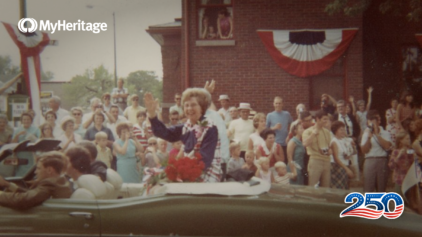
The beating heart of my American pride rests with my 5th-great-grandfather, Samuel Shaw Jr. (1748–1829). He was a bricklayer, a mason, and above all, a Revolutionary War soldier who fought for our independence out of Machias, Maine. Decades after the smoke cleared, he was formally escorted as an honored veteran in the Newburyport Fourth of July parade in 1826, exactly fifty years after the signing of the Declaration of Independence.
Yet, our direct connection to Samuel Jr. was almost completely erased by a single stroke of a genealogist’s pen.
In 1904, a well-known researcher named Harriette Farwell published Shaw Records. In a massive oversight, she accidentally spliced our branch of the family tree onto an entirely different line that had migrated to Minot, Maine, completely omitting Samuel Shaw Jr. She was baffled because Samuel Jr. was not explicitly named in his father Joseph’s final written will. What she failed to realize was a brilliant piece of early American legal nuance: his inheritance had already been securely passed down via an unrecorded, living “Deed of Gift.”
Discovering that our entire lineage could have been lost to a historical mistake was a jarring realization. It makes me deeply grateful for what happened next.
On July 14, 1915, my ancestor, the Honorable Edward Payson Shaw, along with his grandson, Edward Payson Shaw III, decided to fight for the truth. Armed with irreplaceable, 17th-century parchment deeds preserved in the private family chest — including the original 1640 John Crosse deed and that unrecorded living deed — they confronted Farwell. By tracing the physical chain of custody of the land itself, they provided undeniable, tangible proof of our lineage, forcing her to acknowledge the error and restore our family’s true history. Because they rescued our past from oblivion, we can track our legacy directly through 14 generations back to Ralph Shaw.

A Scribe AI analysis of the original colonial land deed from Old Norfolk County, dated November 15, 1647 (click to zoom)
The historic parchment documents John Crosse selling a house and substantial acreage in Hampton (then part of the Massachusetts Bay Colony) to early settler Roger Shaw.
A tradition of leadership
Following the Revolution, our family continued to shape the country’s growth. Samuel Jr.’s son, Major Samuel Shaw (1784–1868), became a legendary horseman, livery owner, and stagecoach driver for the Eastern Stage Company, driving mail and passengers between Newburyport and Boston.
Major Samuel married Abigail Bartlett, which brought a profound piece of American history directly into our bloodline. Abigail was the granddaughter of Edmund Bartlett, whose brother Stephen was the father of Josiah Bartlett: the historic physician, statesman, and proud signer of the Declaration of Independence.
This deep tradition of public service culminated at the turn of the 20th century with my 3rd-great-grandfather, Hon. Edward Payson Shaw (1841–1921). He was an industrial titan who pioneered the use of electricity for street transit, building massive trolley and steamboat networks across New England. He served as a State Representative and State Senator before taking office as the State Treasurer of the Commonwealth of Massachusetts from 1895 to 1901.

An archival clipping from The Boston Herald dated July 5, 1921, announcing the sudden passing of the Honorable Edward Payson Shaw at age 79. Source: OldNews.com
His obituary outlines his storied career as a Massachusetts State Representative, State Senator, and State Treasurer, alongside his foundational work building electric trolley lines and early infrastructure at Salisbury Beach. Notably, the piece confirms his lineage through his mother, Abigail Bartlett, explicitly linking him to Josiah Bartlett, a signer of the Declaration of Independence.
Standing proud at America 250
The lineage moves cleanly down through my great-grandfather James Fullerton Shaw, my grandfather Eldredge Fullerton Shaw (who proudly answered the call to serve in the Coast Guard during World War I), and my grandmother Elva “Ellie” Adele Shaw, down to my father, William Petry, and finally to me.
To look at a diagram of Founder’s Park in Hampton, New Hampshire, and see the memorial stone dedicated to the Shaws is a grounding experience. Knowing that I carry the blood of individuals who legally fought for their place in our history, took up arms in the War for Independence, and held high public office to guide our communities fills me with an overwhelming sense of gratitude and American pride.
As America prepares to celebrate its 250th anniversary, I am reminded that our country’s legacy was built by real people who left behind real records of their dedication. We are the living keepers of their flame, and I could not be prouder to stand as a proven link in that unbroken chain.
Many thanks to MyHeritage user Chelsea Petry for sharing her fascinating legacy with us. Explore more American Family Stories and discover how ordinary families experienced extraordinary moments in U.S. history on MyHeritage’s America 250 hub.