The Lightning Express: The Train Journey That Captured America 100 Years Ago

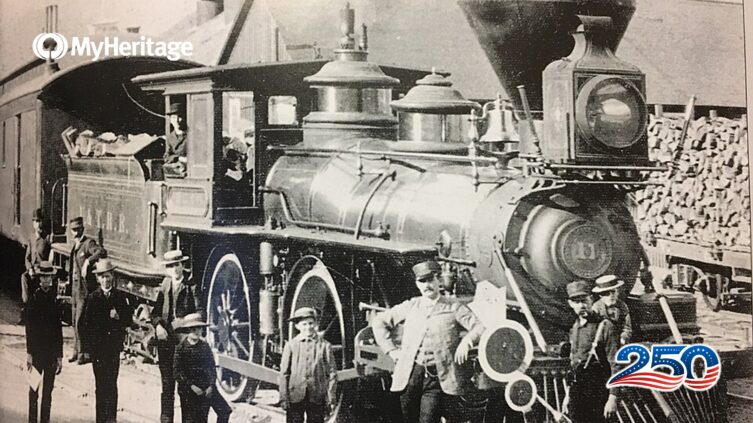
For 3 days in June 1876, Americans watched a train speed across their country — and their imagination. The special transcontinental train, dubbed the “Lightning Express,” traveled from New York to San Francisco in just over 84 hours. This was a journey so fast by 19th-century standards that newspapers treated it as a national event. It began as a publicity stunt, but it became something much more consequential: a preview of modern America.

Key takeaways on the Lightning Express
- Unprecedented speed and efficiency: The Lightning Express completed the transcontinental journey from New York to San Francisco in just over 84 hours, proving that the immense physical distances of the United States could be crossed in a few predictable days rather than weeks of hardship.
- A psychological shift in migration: By demonstrating that coast-to-coast travel could be fast and dependable, the train transformed the American mindset. The West was no longer feared as a remote, dangerous frontier, but viewed as an accessible opportunity where relocation was a calculated, reversible choice.
- Unification of a disjointed nation: What began as a theatrical publicity stunt ultimately accelerated the integration of the American economy and culture, helping to stitch a sprawling, disconnected republic into a unified, mobile, and modern nation.
What made the trip so impactful was not only the speed. It was the sense that the vast distances of the United States — once measured in weeks, cost, and uncertainty — could now be compressed into a few predictable days of travel. In an era when crossing the continent had long meant hardship, improvisation, and delay, the Lightning Express suggested that distance itself was no longer an almost insurmountable obstacle to a new life.
Distance redefined
Before the transcontinental railroad, Americans moving east to west had little choice but to navigate a patchwork of wagons, stagecoaches, steamships, and disconnected rail lines. The country was linked, but not smoothly. Long-distance travel was possible, but never simple. A journey across the continent could take months and invariably involved expense, risk, and extreme physical effort.
That changed in 1869, when the first continuous transcontinental rail line was completed. This allowed the journey to be completed in about a week. Suddenly, people had a practical way to move coast to coast. Travel that once seemed like a once-in-a-lifetime expedition seemed less daunting, if not quite routine. Of course, the trip still involved time and patience, but it no longer demanded the kind of sacrifice that had once defined transcontinental movement.
The Lightning Express built on that transformation. It took the new rail reality and pushed it into the public imagination, showing Americans what the country could feel like when long-distance transportation was fast, coordinated, and dependable.
For family historians, rail expansion can also provide useful context when tracing ancestors through census records, city directories, passenger lists, and other historical records. A sudden move across the country may make more sense when viewed alongside the transportation networks that made it possible.
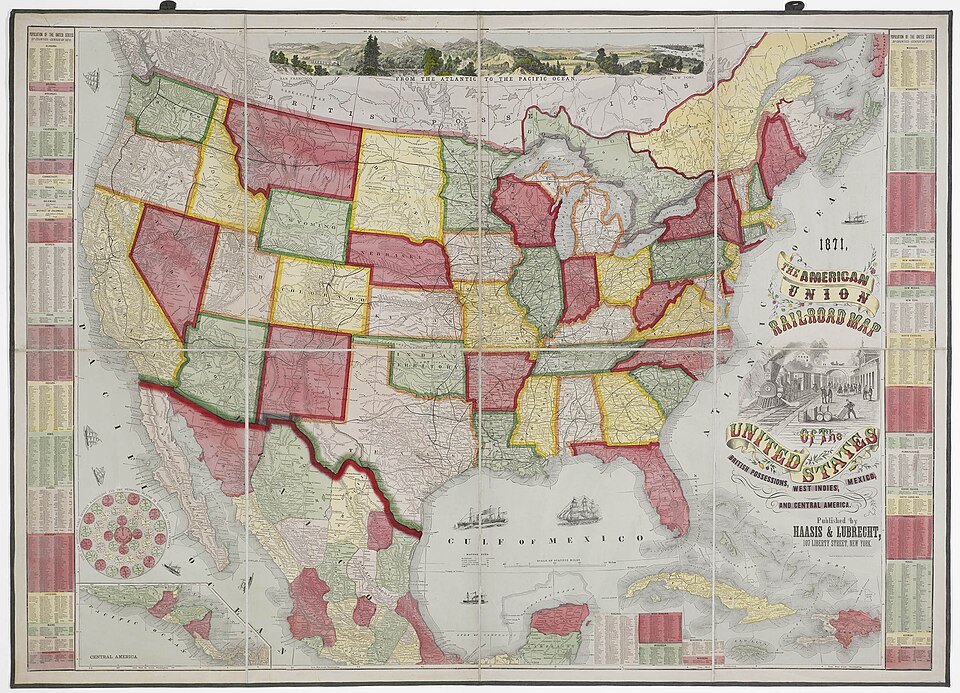
American Union Railroad Map 1871
A spectacle with lasting consequences
The train was originally arranged to promote a theatrical production, which makes the whole episode feel distinctly 19th-century. In truth, it was a business venture, a publicity campaign, and a technological showcase all riding the same tracks. But the result went far beyond spectacle. As the train moved west, newspapers and telegraph reports followed it closely, turning the trip into a shared national story.
That mattered because speed is never just about minutes and miles. The train’s record-breaking journey changed public expectations. It altered what ordinary folks thought was normal, possible, and worth attempting. Once Americans saw a coast-to-coast rail journey completed in little more than 3 days, the country looked different. The West was no longer a remote frontier separated by an almost unthinkable span. It was an opportunity that could be safely tackled.
The psychological effect was powerful. Long-distance migration no longer seemed like a one-way leap into the unknown. It could now be imagined as a calculated and reasonable move — for work, family, or commerce — with a return trip still feasible if things did not work out. Rail travel, along with other innovations like the telegraph, made the country’s distances feel less like a barrier.
A nation that began to move
The deeper legacy of the Lightning Express was that it helped Americans reimagine migration itself. Before rail, the country’s enormous size reinforced regional separation. After rail, that size became something to cross, connect, and use.
This did not erase inequality. Travel still cost money. Access still depended on class, geography, and social position. And not every journey was comfortable or safe. But for many Americans, the train helped make mobility feel normal rather than heroic. That shift in attitude fed into internal migration, trade, and the growth of a more integrated national economy. Towns in the great center of the country gained better access to people and markets, while cities on both coasts became more tightly bound to each other and to the rest of the country.
In that sense, the train’s significance was larger than the stunt itself. It was part of a broader 19th-century process in which railroads, telegraphs, and expanding markets turned a disjointed republic into something much more closely stitched together.
This kind of historical context can help family historians understand why an ancestor may have relocated, changed occupations, or appeared in documents far from home. When building a family tree, details like transportation routes, migration patterns, and local economic changes can turn a name and date into a fuller story.
The future in motion
The Lightning Express arrived in San Francisco as a triumph of engineering, logistics, and publicity. But its real achievement was to give Americans a clear answer to a question they had been asking for decades: could a country this large ever feel connected?
That is why that stunt-inspired trip in June 1876 is much more than an interesting chapter in the history of U.S. railways. The United States seemed to coalesce into something more manageable and more unified. For a nation still defining itself, that mattered enormously. It was a moment when the United States felt newly mobile; when internal migration became less daunting for anyone dreaming of a better life; and when modern America began to emerge.
FAQs about the Lightning Express
What was the “Lightning Express” of 1876?
It was a special transcontinental train that traveled from New York to San Francisco in just over 84 hours, capturing public attention with its remarkable speed.
Why was this historic journey originally organized?
The trip was originally arranged as a business venture and publicity stunt to promote a theatrical production, though it quickly became a national showcase of rail travel and coordination.
How did transcontinental travel change because of this event?
Before railroads, crossing the country could take months of hazardous effort. The 1869 rail line reduced the journey to about a week, and the Lightning Express showed that it could be completed in just days.
What was the psychological impact of the train’s journey on Americans?
It redefined distance. The West began to feel less like a remote frontier and more like an accessible opportunity. Migration could be imagined as a practical move rather than a one-way leap into the unknown.
Did the Lightning Express eliminate social and economic inequalities in travel?
No. Travel still required money, and access depended on class, geography, and social position. However, the journey helped make long-distance mobility feel more normal to a broader portion of American society.
What is the lasting legacy of the Lightning Express?
It helped show that a massive country could feel connected. Its legacy lies in the way it encouraged internal migration, trade, and a more unified national economy.
Daniel Maurice began his career as a diplomat, representing Australia in countries across Europe and Asia, as well as at major UN conferences. He later held chief executive, general management, project delivery, strategy, and advisory roles in Australia, the U.K., and the U.S. His industry experience includes financial services, technology, telecommunications, media, and export trade insurance.