


Good Old Summertime: Our ancestors’ vacations

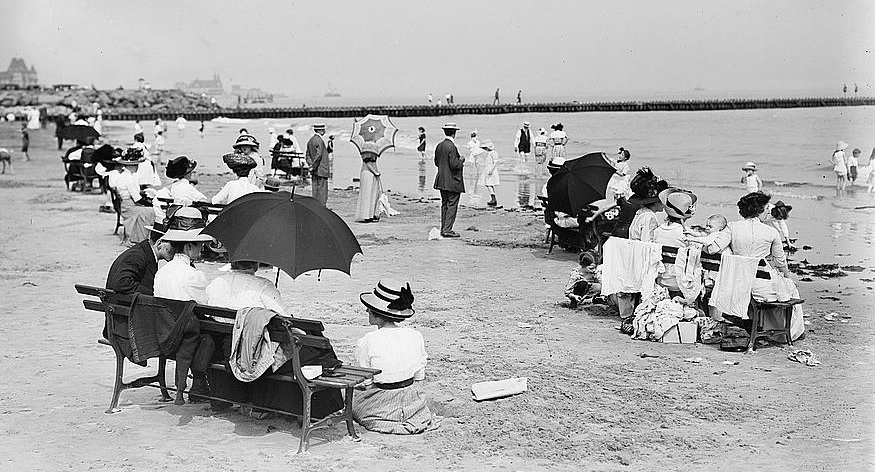
Where did our ancestors vacation? Did they even go on vacations?
As a New York kid, my summers were spent in the Catskills at Kauneonga Lake, where my grandparents had a large bungalow colony named Kauneonga Park. I was born in May and began going there in June – every summer or part of every summer through high school graduation.
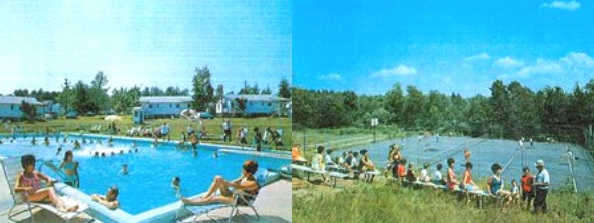
My maternal grandparents, Sidney and Bertha Fink, owned Kauneonga Park. Here are two views of the bungalow colony.
The Catskills, about two hours north of the city, were always a draw for city families. They rented a room, shared a kitchen, went to hotels, or rented a bungalow (a small cottage with one or two bedrooms) for the entire summer. For those at bungalow colonies, the mother and kids were there all summer and the fathers drove up on the weekends. It was an idyllic time, depending on the level of accommodations.
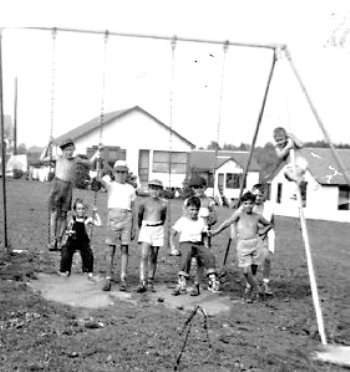
City kids (c1950s) enjoy the summer in the country at Kauneonga Park!
Those who stayed in the hot city visited the beaches, such as Coney Island in Brooklyn and Rockaway in Queens.
My great-uncle probably had the worst summer vacation ever. Accepted to medical school, he realized he hated blood. His mother and aunts got him a summer job at a slaughterhouse to get used to it. I am not sure this qualifies as a summer vacation, but if it does, it really was the worst ever! It did the trick however, and he went off to medical school minus his phobia and on to a long successful career.
What about our ancestors? They certainly led different lives, but unless they were rather wealthy, their options were limited. I’m not sure they thought about vacations when they were busy keeping things together at home, on a farm (where chores never ended), or running a small business.
WHERE DID EUROPEANS VACATION?
In England, families went to the seaside, to Brighton and other towns for a day or two or a week.
In Switzerland, the entire country was a spa! People went to stay up in the mountains, or in the valleys. They hiked, swam in rivers, and enjoyed relaxing times. Numerous hot springs attracted visitors looking for relief for their ailments. Hotels, clinics, and resorts sprung up around these ancient hot springs.
For wealthy Europeans and Americans, options were plentiful. The new network of trains moved people from country to country. The Americans went to Europe on Grand Tours, visiting many countries, museums and absorbing the culture.
In the 17th century, early travelers ranked Spain in the category of Poland, Russia, the Balkans – places considered to be on the edge of civilization. They complained that they had spent two days in Spain not seeing a house or village. Some began a trip in southwest France, headed for Madrid and then Barcelona – also up to Monserrate – and ended in southeast France.
In the 18th century, more romantic travelers went to Spain, Greece, the Near East and Egypt. In the 1830s-40s, Malaga was considered an alternative to the crowded French Riviera which was the most popular destination of all in the 1860s.

The promenade des Anglais, French Riviera circa 1930
GUIDEBOOKS
During the 19th century, Italy was the most popular for northern Europeans going south. Egypt saw increased tourism by the 1880s. The first English edition of a “Guide to Switzerland” was published by Baedeker in 1863; in 1898, the 19th edition was published. The same publisher’s Central Italy guide was in its 13th edition that year – and its first English edition was published in 1867.
In 1892, O’Shea’s “Guide to Spain and Portugal” indicated there were more than 2,000 mineral springs in Spain, but only 171 were listed as spas.
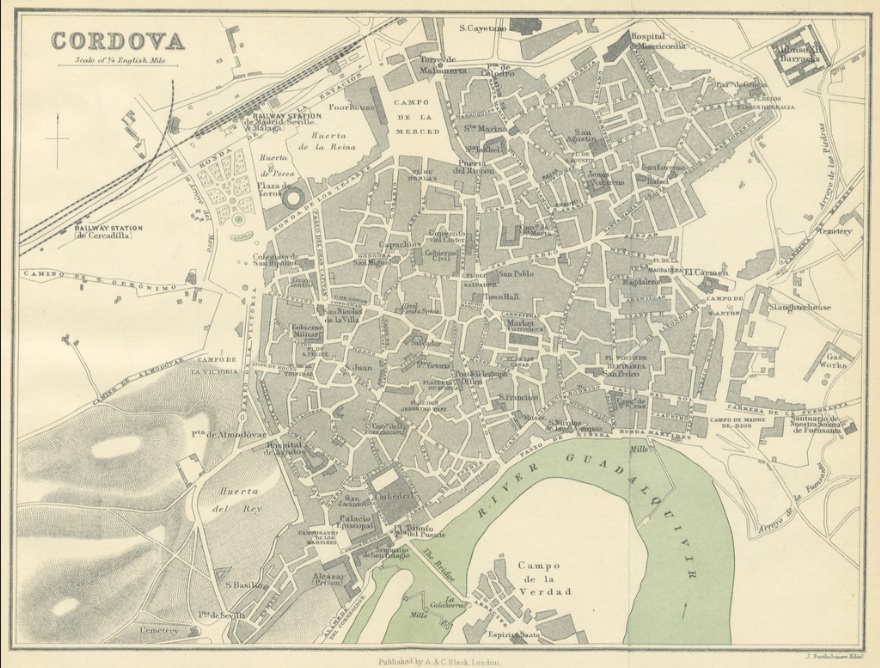
Map of Cordova from O’Shea’s Guide to Spain and Portugal
“The Queen Newspaper Book of Travel 1914” ranked upper-middle-class tourist destinations. France had 64 pages; Switzerland, 53; Germany, 35; Italy, 21; Austria-Hungary, 20; Scandinavia, 20; Spain and Portugal, 13, and Belgium and Holland, 12 pages.
One of the most famous tourism companies was Thomas Cook. In 1869, It began organizing package tours to Switzerland, Italy, the US, and Egypt.
For an interesting article on the history of leisure and tourism in Spain, click here.
WATCH OUT FOR WOLVES AND FOXES!
When my daughter and a friend went to Spain a number of years ago, I went looking for an old guidebook. An early 18th-century Spanish guidebook at the Library of Congress (Washington, DC) said about the village they were going to, hay muchos lobos y zorros. There are many wolves and foxes, so be careful. They reached Zaragoza and took a taxi to the medieval village, some 30km away. The driver said to them that they should be careful – hay muchos lobos y zorros. He didn’t quite understand why his passengers were laughing hysterically. Nothing much had changed there in 200 years!
In Spain, many English tourists began arriving after the 1845 publication of Richard Ford’s two-volume “Handbook for Travellers in Spain and Readers at Home,” an early travel guide. It sold out in about a year. Ford, who traveled by horse around Spain in the 1830s, recommended the following travel attire:
…a jacket of black sheepskin or lambskin, with, in his words, “a sash around the waist which sustains the loins and maintains an equable heat over the abdomen,” a cloak, and in summer “the head should be protected with a silk handkerchief tied after a turban fashion, which all the natives do, in addition we always lined the inside of our hats with thickly-doubled brown paper.”
He and his wife included some 500 sketches – some are the only record of buildings or locations that have changed beyond recognition or have disappeared over time.
Spain became much easier to navigate once the railroad network was constructed. Eventually, steamships ran from London, Liverpool and Southampton, taking about a week to reach Cadiz or Malaga. One could reach Madrid from Paris in 32 hours by train.
Old guidebooks indicated seasonal travel patterns to visit Spain. Spring and autumn were for Madrid and central Spain. Autumn, winter and spring were best for Seville, Valencia, Barcelona. Late spring was for the Pyrenees, when the snow melted.
HEALTH AND WELLNESS VACATIONS
In Moscow and St. Petersburg, individuals with certain conditions were advised by medical doctors to go to Italian hill towns for clean mountain air and water. Some recommended specific hotels and spas – perhaps they received commissions. Cemeteries in those towns often have the gravestones of foreigners. In fact, one of our long-ago young Moscow Talalai cousins went there, but the clean air and water didn’t help him. His gravestone noted that he had died of tuberculosis.
In Germany, people went to “take the waters” in places like Weisbaden and other resorts, built around ancient hot springs. Their days included exercise by walking, medical treatments, and drinking the waters of the thermal springs. Each spring’s chemical analysis was considered important for specific ailments. The history of Weisbaden begins around 3000 BC and goes through the peak of tourism in the 19th century.

The Hot Spring, Wiesbaden, Germany. Aquatint by F. Martens
Try this for a peek at what the Russian tourists experienced in Italy.
While many of our ancestors in the late 1800s and early 1900s were leaving Europe for the New World, those in Europe who could travel were really getting around. And many of our ancestors who had “made it” in the New World were returning to Europe for Grand Tours.
Where did your ancestors vacation, if they did?








Kitty M Cooper
August 30, 2018
Wonderful article Schelley!
Thought I would share the recollections of my Dad’s summers in the Catskills in the 1920s
My favorite line is “Conversation, a much-neglected art today, was an important part of our lives. “